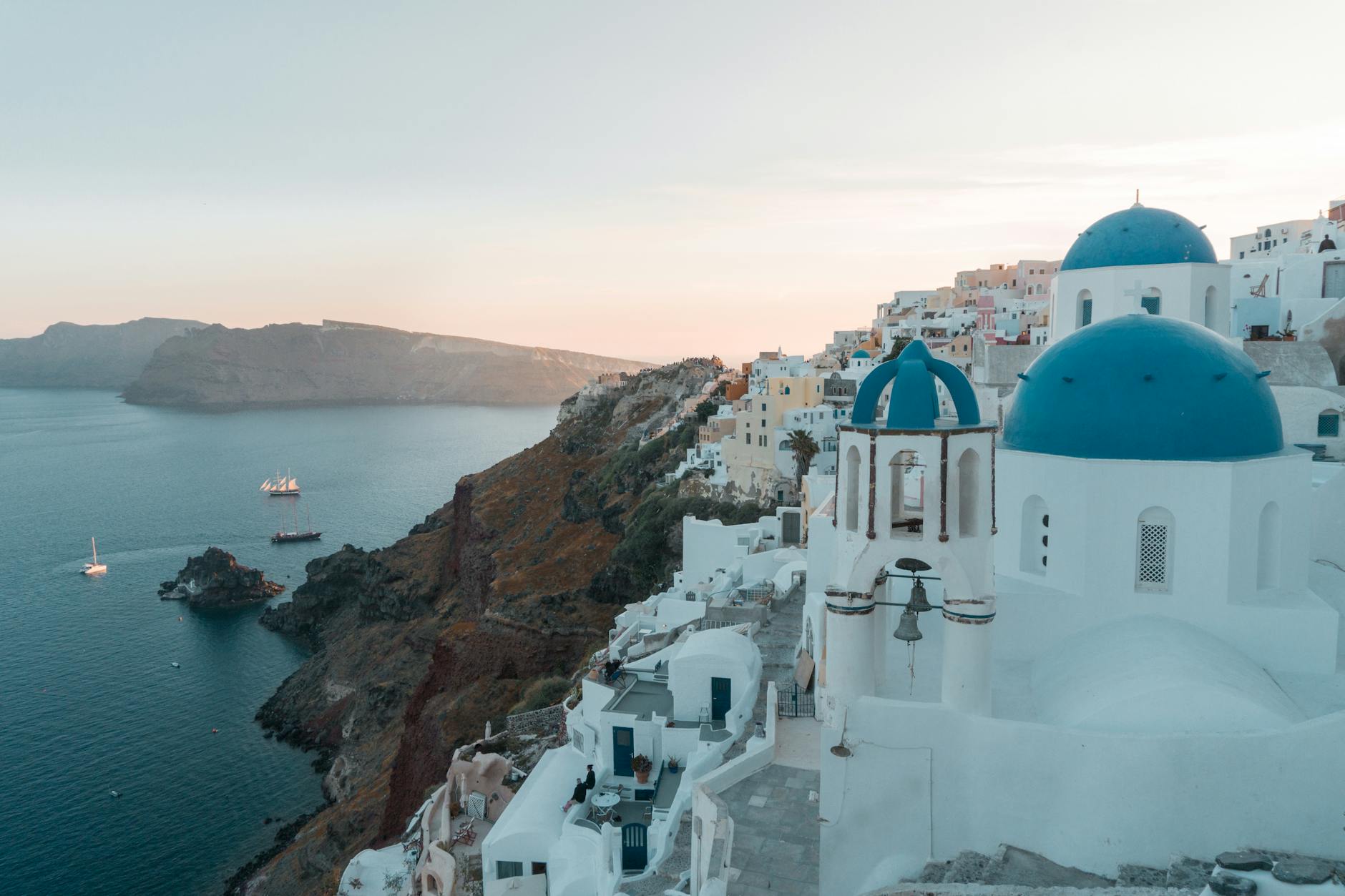
Santorini has a tide, and it isn’t the sea. On days when cruise ships are in port, thousands of day-trippers pour into Fira and Oia through the middle of the day, then head back to their ships by evening. Plan your three days around that pattern — eat lunch where the buses don’t stop, walk the caldera before the cable car queues form, and watch sunset somewhere that isn’t Oia’s castle — and the island feels far calmer.

Timing: When Cruises Dock and When to Disappear
Cruise arrival schedules are published by the port and by cruise-tracking sites, and you can check them a few days out. On heavy days the old port and the Fira cable car fill up in the morning, and the flow reverses in the late afternoon. That gives you two quieter windows: early morning and evening.
Treat those hours as the time for the caldera walk, the blue domes, and the cliffside cafes. The middle of the day is for inland villages (Pyrgos, Megalochori, Emporio), wineries, archaeological sites, and beaches — anywhere a tour bus doesn’t park.
Day 1: Fira to Imerovigli Caldera Walk
Start early from Fira’s main square with a bakery spinach pie and a coffee. The cliffside path north to Firostefani and Imerovigli follows the caldera rim and is a few kilometers one-way.
In Imerovigli, walk out to Skaros Rock, the site of a medieval fortress on a promontory with a wide caldera view. Take care on the uneven ground. Be back in Fira before the cable car queues build and the cliffside paths fill up.
Spend midday inland. Take the local KTEL bus to Pyrgos, the island’s old capital, perched on a hill. Climb to the kastro ruins, eat lunch at a taverna away from the caldera edge, and rest somewhere shaded. Return to Fira in the evening. Sunset from the Three Bells of Fira is usually quieter than Oia’s.
Day 2: Wineries + Akrotiri (Check Red Beach Before You Go)
Santorini’s assyrtiko is the island’s wine headline. Volcanic soil and basket-trained vines (the kouloura — coiled to protect grapes from wind) make the vineyards look like nowhere else. Several wineries welcome visitors for tastings.
A self-driven loop starting from Pyrgos: Santo Wines, Venetsanos and Gavalas in Megalochori, and Artemis Karamolegos, which has a restaurant. Tasting prices vary, so check each winery’s current prices and opening hours, and book lunch ahead in summer. If you’re driving, taste only a little or arrange a driver.

In the afternoon, drive to Akrotiri, the Bronze Age city buried by a volcanic eruption and now sheltered under a large protective roof. It is often compared to Pompeii, with frescoes, multi-story houses and drains. Check the Ministry of Culture’s site page or the ticket office for current hours and entry prices.
A note on Red Beach: access to the beach has been restricted at times because of rockfall from the cliffs. Check current status locally before you go and heed warning signs. Vlychada (white pumice cliffs that look like a moonscape) and Perissa (long black sand beach with loungers) are both good alternatives.

Day 3: Oia at Sunrise (Not Sunset) + Boat to Thirassia
This is the day many visitors get wrong. Oia at sunset is packed with people crowding onto the castle ruins and nearby walls to watch the sun go down.
Go at sunrise instead. Arrange transport the night before, because few buses or taxis run that early. The light hits the white buildings early in the morning, and you’ll likely have the lanes largely to yourself before the day-trippers arrive.
Walk down the steps to Ammoudi Bay, taking care on the polished stone. From Ammoudi, small boats run across to Thirassia, the quieter sister island. Check boat times and prices at the harbor, plan your return in advance, and spend the day there with lunch at one of the tavernas.

Best Bases: Fira, Imerovigli, Pyrgos, or Oia?
Where you sleep changes the trip more than what you do.
- Fira — central, loud, the best bus connections, midrange pricing. Best for first-timers.
- Imerovigli — quieter, the highest caldera point, walkable to Fira. Best for couples and view-focused stays.
- Oia — the postcard, the most expensive, the most crowded by day. Best if you want the photo and have the budget.
- Pyrgos or Megalochori — inland villages, usually cheaper, no caldera view but a quieter local feel. Best for repeat visitors and travelers who want the wineries on their doorstep.
In peak summer, an inland village can be a calmer and cheaper base. In the shoulder months, a caldera-view stay in Imerovigli is the draw.
Money & Ferry Logistics
Greece uses the euro. ATMs are easy to find in Fira and Oia and scarcer in the villages. Carry some cash for tavernas, beach loungers, and small boat tickets; cards are widely accepted at hotels, wineries, and larger restaurants. Tipping is appreciated but not expected.
💱 1USD ≈ 0.9EUR
Ferries link Santorini with Athens (Piraeus), Crete and other islands. Ferryhopper is a ferry booking site where you can compare current schedules, crossing times and fares; fast and conventional ferries differ a lot in both. Ferries can be disrupted by weather and strikes, so keep some flexibility around your onward travel.
The airport sits inland on the east side of the island. Taxis and the public bus (KTEL) connect it with the main towns, so check current fares and timetables before you land. Quad rentals are common, but quad and moped accidents cause serious injuries and deaths in Greece, and travel insurance often excludes quad biking (UK FCDO). Consider a small car or the buses instead. The KTEL network covers the villages most visitors want to reach.
FAQs
Is Oia sunset worth the crowd?
It is very crowded. Oia at sunrise has fewer people. Alternatives for sunset are Imerovigli, Fira’s Three Bells, or the Pyrgos kastro ruins.
Should I rent a quad or a car?
A small car or the bus is the lower-risk choice. The UK FCDO says quad biking and moped accidents cause serious injuries and deaths in Greece, that hire-company insurance is usually third-party only, and that standard travel insurance often excludes quad biking. If you do ride one, wear a helmet and check your licence and insurance cover first (UK FCDO).
Is Santorini safe for solo travelers?
Most visitors have trouble-free trips, but take normal precautions. The UK FCDO says thefts of passports, wallets and handbags are common in crowded tourist places in Greece, so keep valuables secure. Other risks to plan for are scooter and quad accidents, heat in summer, wildfire risk between April and October, and earthquakes (UK FCDO). Watch your footing near caldera edges, especially after dark, and use a phone light on the walk back from sunset.
When is the cheapest time to visit?
Prices are generally lower outside the peak summer months. Ferry timetables are reduced in the off-season, and many seasonal businesses close for winter, so confirm opening dates for the hotels and restaurants you want. May and early October are a popular compromise — warm, mostly open, and quieter than midsummer.
Do I need to book the cable car?
Not usually, but queues can build during the middle of the day when cruise ships are in port. There is also a long stepped path between the old port and Fira, but it is steep, so take care and carry water in summer heat.
Sources
- Visit Greece — Santorini — official Greek tourism board, transport and site basics.
- Santorini Wine Tourism — winery list, opening hours, the assyrtiko background.
- Ferryhopper — Santorini routes — live ferry schedules and booking.
- Wikivoyage — Santorini — non-commercial overview, bus and base-town comparison.
- Akrotiri Archaeological Site — Ministry of Culture — official site, hours and ticketing.
Hero photo: see public/images/blog/santorini-3-days-hero.json. Inline photos: see docs/image-licenses/santorini-3-days.md.
Heads up! Some links on this page are affiliate links. We may earn a small commission at no extra cost to you. This helps us keep Traveloonie running and free for everyone.
Last updated 2026-10-29.