Seven days in the Swiss Alps is a tight window, but it’s enough to anchor in three very different places — a valley village, a car-free mountain town under the Matterhorn, and a lakeside city — and feel each one properly.
Day 1-3: Lauterbrunnen Base (Mürren, Schilthorn, Trümmelbach)
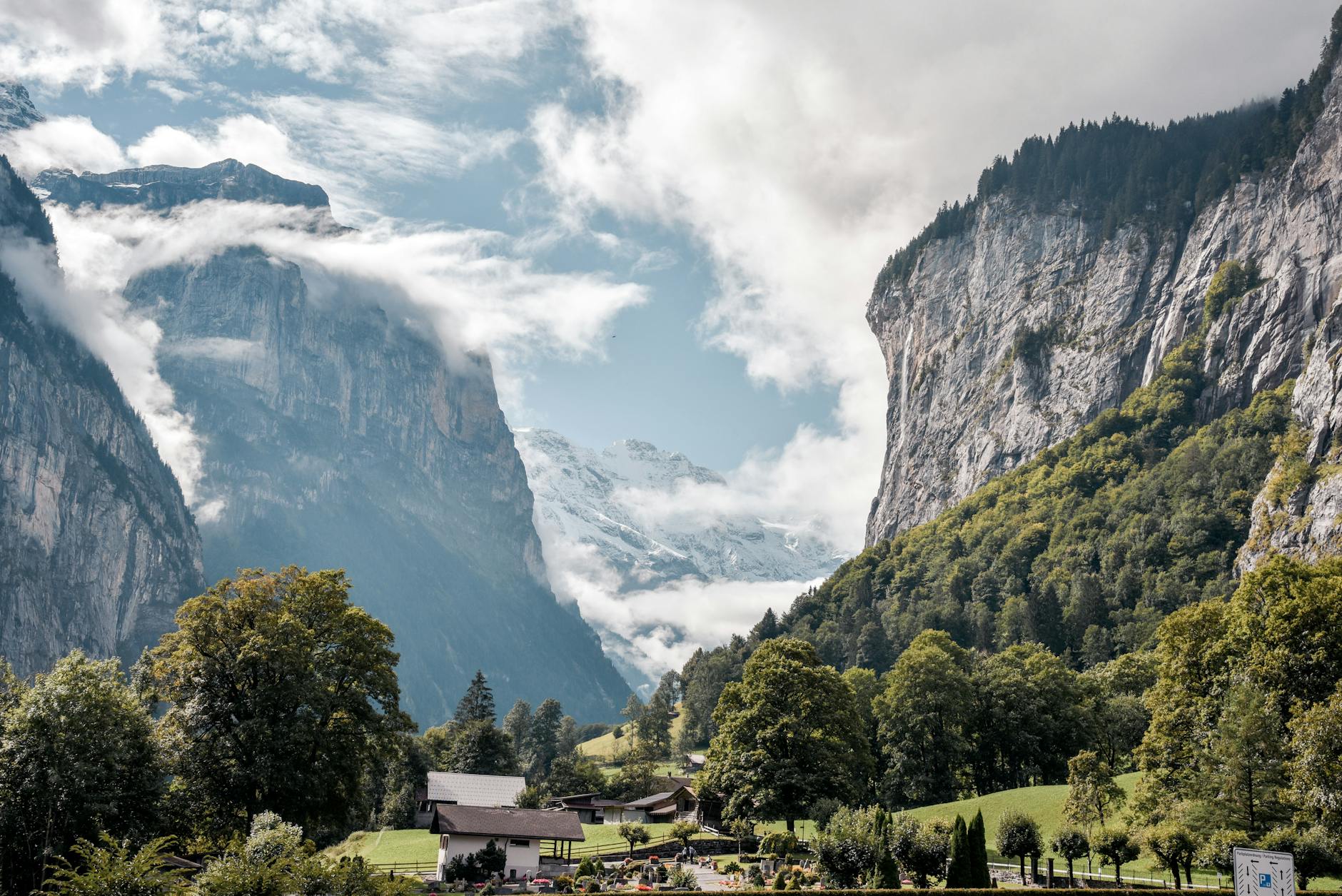
Lauterbrunnen Valley is the headline image of Switzerland — a flat green floor walled by vertical cliffs, with seventy-two waterfalls. The valley village itself is convenient but busy; consider basing up the cliff in Mürren (car-free, reached by cable car and mountain railway from Stechelberg or Lauterbrunnen). Wengen, on the opposite shoulder, is the other strong option and faces the Jungfrau more directly.
Day 1 is arrival and acclimation: walk the valley floor to Trümmelbach Falls, ten glacial cataracts roaring through the inside of a mountain. Day 2 goes up: the cable car to Schilthorn (2,970 m) for the Piz Gloria revolving restaurant and a 360° panorama that includes Eiger, Mönch, and Jungfrau in a single sweep. Day 3 is a hiking day — the North Face Trail from Mürren back down toward Gimmelwald is gentle, well-signed, and serves Eiger views the whole way.

If the weather collapses (it does, even in July), pivot to Interlaken for the day — paragliding launches off Beatenberg, and the Harder Kulm funicular is an option when the high peaks are clouded out (check its status for the day).
Day 4-5: Zermatt + Matterhorn (Gornergrat Sunrise)
Travel day. From Lauterbrunnen, the route is Lauterbrunnen → Interlaken Ost → Spiez → Visp → Zermatt, with changes along the way; journey planners show roughly three hours or a little more, so check the exact connections on sbb.ch. Zermatt is car-free; you park in Täsch and ride the shuttle train up.
Zermatt earns its reputation. The Matterhorn is visible from the village streets and dominates the skyline. Spend Day 4 low: walking the Kirchbrücke at golden hour for the postcard reflection, and stretching legs on the easy lakes loop to Leisee via Sunnegga.

Day 5 is the early alarm. The Gornergratbahn’s first train leaves Zermatt at 07:00 in the 2026 summer season (Gornergrat timetable), and the summit is above 3,000 m. That is after sunrise in summer, so expect early-morning light rather than the sunrise itself. Bring layers — it is much colder at the top than in the valley. Hike back partway via Rotenboden to Riffelsee for the famous mirror-pond reflection shot, then drop the rest by train.
Day 6-7: Lucerne (Lake, Mt. Pilatus, Old Town)
The transfer from Zermatt to Lucerne is a long train day with changes; one scenic option follows the Glacier Express corridor through Andermatt, while the standard SBB routing runs via Visp and Bern. Check journey times and fares on sbb.ch.

Lucerne lowers the altitude and the intensity. Day 6 is the Chapel Bridge (Kapellbrücke), the painted wooden footbridge over the Reuss, plus a slow afternoon around the Old Town — Weinmarkt, the Lion Monument, the Bourbaki Panorama. A lake cruise on the Vierwaldstättersee at sunset is the right way to end the day.

On Day 7, go back up — Mt. Pilatus by the “Golden Round Trip”: boat to Alpnachstad, the cogwheel railway up (billed by Pilatus as the world’s steepest), gondola and cable car down via Kriens. It takes most of a day, needs no rental car, and runs from May to October (Pilatus).
Getting There
Zürich (ZRH) is the main gateway and has its own SBB rail station at the airport, with onward connections toward Lucerne, Bern and Interlaken; check sbb.ch for current routes and journey times. Geneva (GVA) works if you’re starting in the west.
The Half Fare Card vs Swiss Travel Pass (Math)
This is the single decision that defines a Swiss trip’s budget, and most one-week visitors get it wrong.
- Swiss Travel Pass (8 consecutive days, 2nd class): the official Swiss Travel Pass page listed about 542 USD for adults when checked, and the price shown at checkout is the binding one. Swiss Travel System announced an average increase of about 5% for passes starting in 2026. It covers unlimited SBB trains, boats and most city transit. Some mountain railways (Rigi, Stoos, Stanserhorn) are free, and most others, such as Gornergrat and Titlis, get a discount of about 50%. Entry to more than 500 museums is included.
- Half Fare Card (1 month): 150 CHF from 1 January 2026, up from 120 CHF (Switzerland Tourism). It cuts about 50% off most public transport and many mountain railways, but you still buy individual tickets.
Which one wins depends on how much full-fare travel you would otherwise buy. Price your actual list of train legs and mountain excursions on sbb.ch, then compare the total against the pass price. A trip that stays in one base and skips the big lifts tends to favor the Half Fare Card; a trip with several long train legs and mountain excursions, like the one above, can favor the Swiss Travel Pass.
When to Go: June-September Window
Alpine summer is short. Late June through mid-September is generally the stretch when most high-altitude lifts, huts, and passes are open. July and August are peak — busier trails, full hotels, premium prices. June can still have snowfields on the high traverses, and September can bring early snow at altitude. Outside this window, expect closures or reduced timetables on many cable cars and mountain restaurants, and check each operator’s season dates (Pilatus’ Golden Round Trip, for example, runs from May to October).
Weather changes hourly above 2,000 m. Build at least one buffer day per base so you can swap a clouded-out Schilthorn morning for a clear Jungfraujoch the next day.
Money & Logistics
Switzerland uses the Swiss Franc, not the euro. Cards are accepted virtually everywhere including mountain huts; cash is useful only for very small village bakeries.
Yes, it is expensive. Hotels and restaurants in the resort villages are pricey in summer, and a single mountain return ticket can top 100 CHF without a pass or discount card (the Gornergrat return is one example). Coop and Migros supermarkets are the budget lever — picnic lunches at viewpoint benches are completely normal local behaviour and cost far less than a restaurant meal.
Tap water is excellent everywhere, including from village fountains marked “Trinkwasser.” Tipping is not expected; rounding up is plenty.
FAQs
Is the Swiss Travel Pass worth it for one week?
For an itinerary like this one — three bases, several big mountain excursions, multiple long train legs — it can come out ahead. For a slower trip that stays in one valley and skips the big lifts, the Half Fare Card is more likely to win. Build your real ticket list on sbb.ch first, then decide.
Best base: Lauterbrunnen, Wengen, or Mürren?
Lauterbrunnen for convenience (trains run latest, restaurants and supermarkets in walking distance). Wengen for the Jungfrau view and a calmer village feel. Mürren for the highest perch, car-free silence, and the easiest access to the Schilthorn.
Do I need a car?
No, and we’d argue against it. Swiss trains are punctual to the minute, run everywhere, and many of the best mountain towns (Zermatt, Mürren, Wengen) are car-free anyway. Parking in resort villages is also painfully expensive.
Is Switzerland really as expensive as people say?
Yes. The shock is real, particularly at restaurants and on mountain cable cars. The fix is to mix it: supermarket breakfasts and lunches, one nice dinner per base, and the right rail pass for your specific route. Price your own list of hotels, trains and lifts before you book, because totals vary widely with season and style.
How many days do I need for Switzerland?
Seven is the floor for the classic three-base loop above. Ten lets you add Bern or the Glacier Express slow route between Zermatt and St. Moritz. Less than five and you’re better off picking one valley and going deep.
Sources
- Switzerland Tourism — myswitzerland.com
- SBB / Swiss Federal Railways — sbb.ch
- Jungfrau Railways — jungfrau.ch
- Schilthorn / Piz Gloria — schilthorn.ch
- Gornergrat Bahn — gornergratbahn.ch
- Pilatus — pilatus.ch
- Wikivoyage — Switzerland
Hero photo: see public/images/blog/swiss-alps-summer-week-hero.json. Inline photos: see docs/image-licenses/swiss-alps-summer-week.md.
Heads up! Some links on this page are affiliate links. We may earn a small commission at no extra cost to you. This helps us keep Traveloonie running and free for everyone.
Last updated 2026-10-29.